
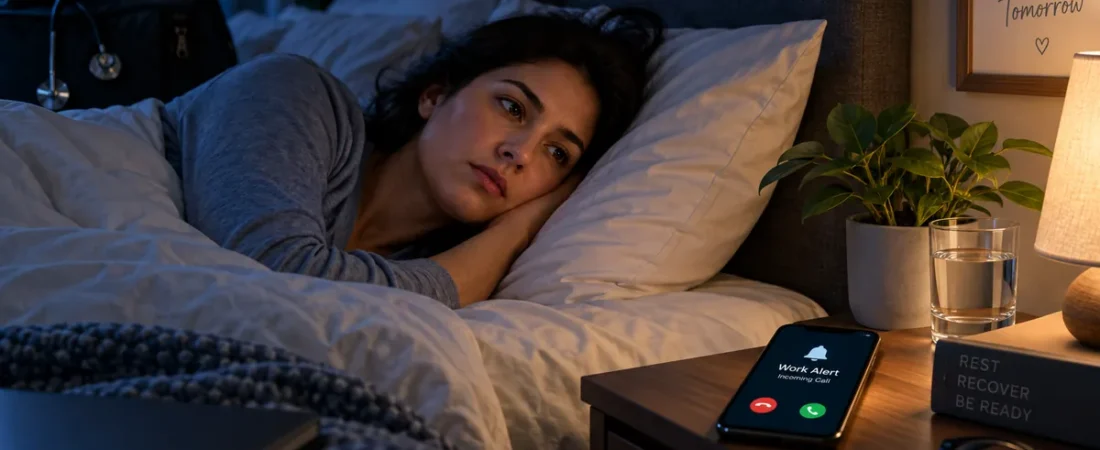
You’re technically allowed to sleep, but part of your mind is still waiting for the phone to ring.
Every sound gets your attention. You check your phone again. You start wondering whether it’s even worth falling asleep when you could be called at any moment.
If you can’t sleep while on call, the uncertainty itself can make your night feel very different from a normal night of rest.
Instead of trying to create a perfect bedtime routine, the goal is to make the sleep opportunity you do have as comfortable and practical as possible.
Why Can Being On Call Make It Hard to Sleep?
Being on call can put you in an unusual situation: you’re supposed to rest, but you also need to be ready to respond.
You may find yourself listening for your phone, checking notifications, or wondering whether an alert will arrive just as you start falling asleep.
If you can’t sleep while on call, part of the problem may be that your night doesn’t feel completely protected from interruption. Instead of expecting it to feel like a normal night, focus on making the available sleep time as restful as you realistically can.
Make Sure the Alert Can Wake You—Then Stop Checking
Before bed, make sure your required alert is loud enough, your phone is charged, and any necessary notification settings are working.
Once you know the system is ready, try to avoid repeatedly checking your phone simply to make sure you haven’t missed something.
A simple pre-sleep check can give you a clear stopping point:
Phone charged → alert volume checked → required notifications enabled → phone within reach → rest.
Follow your employer’s or organization’s required on-call procedures first, especially if you work in healthcare, emergency response, IT, or another safety-critical role.
Create a Simple On-Call Sleep Setup
Keep the things you may need during an alert easy to reach so you don’t have to fully switch into “morning mode” every time you wake.
Depending on your work, that might mean keeping your phone charger, glasses, water, required device, or work essentials in the same place each night.
Your bedroom can still remain comfortable for sleep. Dim bedside lighting, comfortable bedding, and a sleep environment that isn’t unnecessarily bright or noisy can make returning to bed easier.
On-Call Comfort Picks — Coming Soon
We’re researching practical products that may make on-call nights easier, including adjustable bedside lighting, charging solutions, comfortable pillows, sleep masks, and other nighttime essentials.
Any product used during on-call periods should still allow you to reliably receive the alerts your role requires.
What to Do After an On-Call Wake-Up
Once you’ve handled the alert, returning to sleep can sometimes be harder than waking up in the first place.
If possible, keep unnecessary lighting low and avoid adding activities that make you more alert before returning to bed.
Try not to turn one interruption into an extended period of checking messages, scrolling, or watching the clock.
Your goal isn’t to force yourself to fall asleep immediately. It’s simply to give yourself another opportunity to rest.
The Morning After an Interrupted On-Call Night
Some on-call nights may barely interrupt your sleep. Others may leave you feeling as though you hardly rested at all.
Notice how the night actually went before expecting yourself to function exactly as you would after uninterrupted sleep.
If your work involves driving, operating equipment, patient care, or other safety-sensitive responsibilities, fatigue deserves particular attention. Follow your workplace policies and professional guidance rather than relying on a general sleep article to determine whether you’re fit for duty.
Research from CDC/NIOSH recognizes that demanding work schedules and insufficient or disrupted sleep can contribute to fatigue, which is especially important to consider in safety-sensitive work.
Notice Your On-Call Sleep Patterns
One difficult night doesn’t tell you much. Repeated on-call nights can reveal more useful patterns.
For example, you might notice that you sleep reasonably well until the first alert, struggle most with falling back asleep, or feel particularly tired after nights with several short interruptions.
A simple record can help you look beyond “I slept badly” and understand which part of the night is causing the most difficulty.
When Persistent Sleep Problems Need More Attention
If difficulty sleeping continues even when you aren’t on call, regularly affects your daytime functioning, or is becoming difficult to manage, consider discussing it with a healthcare professional.
On-call schedules can be demanding, but persistent sleep problems shouldn’t automatically be assumed to be caused by work alone.
A Simple Way to Plan Around On-Call Nights
Cozy & Well is developing an On-Call Sleep & Recovery Planner for people whose nights can change with a single alert.
Instead of being another generic sleep tracker, it will help you map what actually happens:
On-call period → sleep opportunity → alert → response → return to rest → morning recovery
The toolkit can include an On-Call Sleep Map, interruption tracker, pre-sleep checklist, recovery planner, and pages for identifying patterns across multiple on-call nights.
Coming Soon — On-Call Sleep & Recovery Planner
The Bottom Line
If you can’t sleep while on call, expecting yourself to completely forget about the possibility of an alert may not be realistic.
Instead, prepare what you need before bed, make sure required alerts can reach you, and then give yourself permission to use the available time for rest.
Pay attention to what makes your on-call nights hardest—waiting for the first alert, repeated interruptions, falling back asleep, or recovering the following morning.
Once you understand the pattern, you have a much clearer idea of what to work on.